 Remi d'Almeida11 min read
Should a Solo Developer or Small Business Buy a M5 Ultra for Local AI?
Compare the 256GB M5 Ultra with $200–$400/month cloud AI on cost, local model performance, concurrency, and inference sovereignty.
On this page
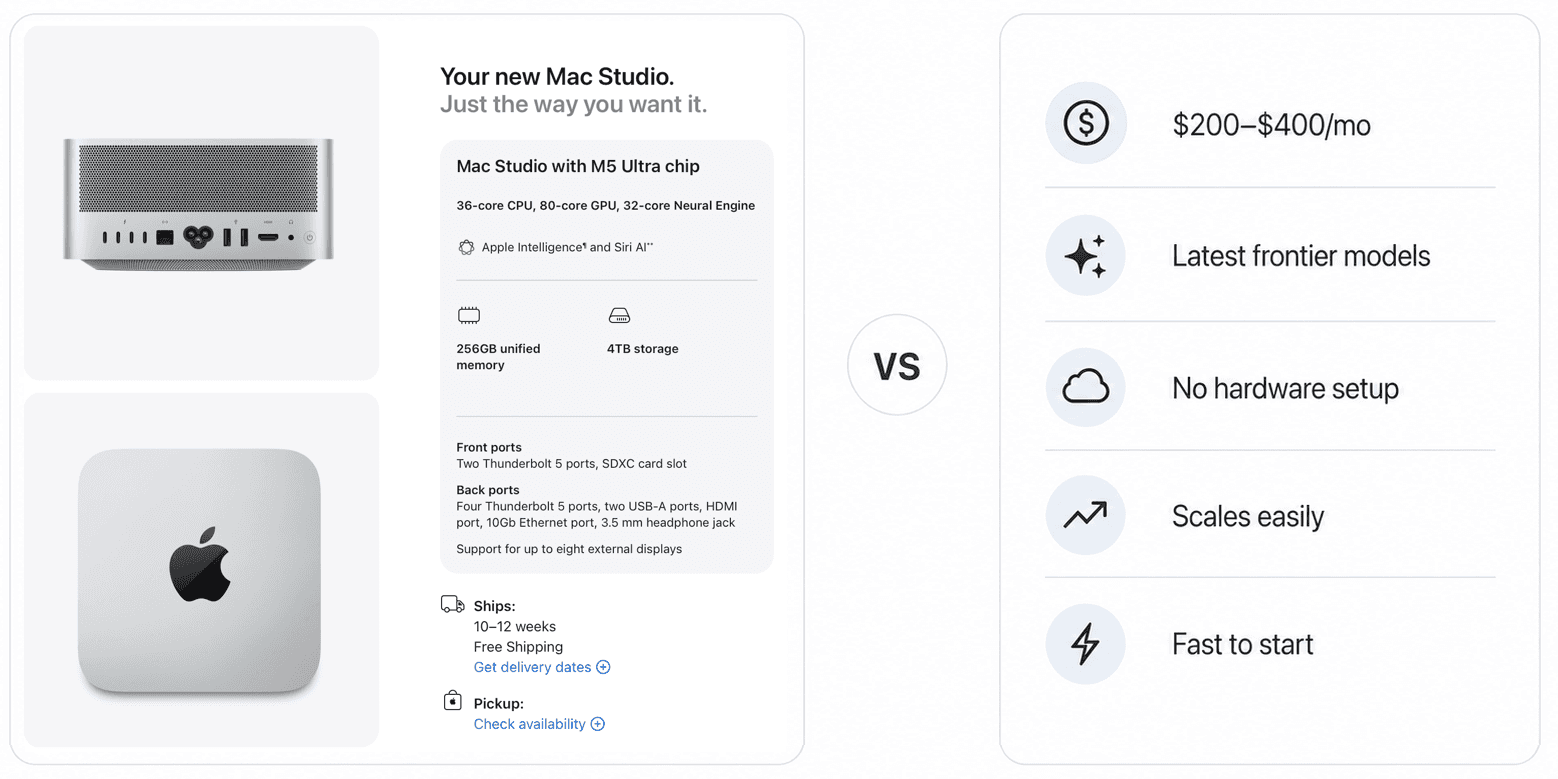
Apple's new Mac Studio with M5 Ultra is an extraordinary machine for local AI.
The configuration we looked at has:
- 36-core CPU
- 80-core GPU
- 32-core Neural Engine
- 256GB unified memory
- 1.2TB/s memory bandwidth
- 4TB SSD
- $12,299 price
Apple also offers the M5 Ultra with up to 512GB of unified memory. That combination of very large unified memory and 1.2TB/s of bandwidth makes it possible to run models locally that simply do not fit on conventional consumer GPUs.
That raises an obvious question:
Why spend $12,299 on an AI inference machine when $200 — perhaps $400 for greedy users 👀 — per month already gives a developer access to enough frontier cloud AI?
For a solo developer, I think the financial answer is fairly clear.
For a small business, it becomes more nuanced.
And after looking at the numbers, I don't think cost is ultimately the most compelling reason to buy one.
The more interesting argument is inference sovereignty.
$12,299 versus $200 per month
Start with the simplest comparison.
| Period | $200/month subscription |
|---|---|
| 1 year | $2,400 |
| 2 years | $4,800 |
| 3 years | $7,200 |
| 5 years | $12,000 |
| 61.5 months | $12,300 |
The purchase price of this M5 Ultra therefore represents slightly more than five years of a $200/month AI subscription.
As of September 2026, ChatGPT Pro's highest-usage tier costs $200/month and includes Codex alongside OpenAI's advanced models and tools. Anthropic's Claude Max 20x plan also costs $200/month and includes Claude Code.
So the $400 version of the comparison is not purely hypothetical: a very heavy user could pay for both and still spend much less upfront than the Mac Studio.
The comparison is not perfect.
The Mac retains some resale value. It can perform other workloads. And once you have bought it, running another million tokens does not create another API bill.
But local inference also has costs that the $12,299 purchase price does not capture:
- electricity
- deployment
- model evaluation
- monitoring
- inference-runtime maintenance
- backups
- downtime
- engineering time
For a single developer who simply wants the strongest AI assistant available, the cloud is extremely difficult to beat economically.
And there is another, more fundamental issue.
A local DeepSeek isn't a local GPT-5.6 Sol or Claude Fable 5
Buying 256GB of unified memory does not suddenly give you a local copy of the best proprietary frontier models.
Today, that comparison includes models such as GPT-5.6 Sol and Claude Fable 5.
OpenAI positions GPT-5.6 Sol as its flagship model for complex professional work across coding, knowledge work, research, science, computer use, and other demanding tasks. Anthropic positions Claude Fable 5 for long-running, difficult knowledge and coding work.
Those weights are not something you can download onto your Mac Studio.
What the M5 Ultra gives you instead is the ability to run extremely large open-weight models.
And that is still remarkable.
What can 256GB actually run?
One model we studied in detail is:
DeepSeek-V4-Flash-Vision-Exp UD-Q4_K_XL
The GGUF is approximately 155GB, representing a model of roughly 305B total parameters, with about 13B language parameters active per token.
That leaves around 101GB of gross physical memory beyond the model file itself.
Not all of that is actually free for inference. macOS, Metal buffers, runtime scratch space, the KV cache, vision processing, and other allocations also need memory. Previous Apple Silicon testing shows that actual working-set requirements can be substantially greater than simply subtracting the GGUF size from physical RAM.
Still, this is the kind of workload where Apple's unified-memory architecture becomes genuinely interesting.
A 155GB model on one compact desktop is something conventional consumer GPUs simply cannot accommodate.
Let's use a realistic 64K context
Tokens per second are meaningless without context about how the model is being run.
A benchmark at 2K context can look excellent while giving a poor picture of a real coding, RAG, or agentic workload.
For this analysis, I would use 64K context with F16 K/V cache as the target configuration.
What performance should we expect?
At 64K context with F16 K/V cache and one active generation, our current planning range is approximately:
10–20 output tokens/second using a general-purpose runtime such as llama.cpp.
A highly optimized DeepSeek-specific runtime might potentially reach around:
22–35 output tokens/second.
But the second number should be considered upside, not an expectation.
Most importantly:
These are estimates, not measured M5 Ultra benchmarks.
The exact Unsloth quantization is very recent and there is not yet a reproducible benchmark for this model on the new M5 Ultra. The estimates use existing Apple Silicon results and the M5 Ultra's higher memory bandwidth as proxies.
Until someone actually puts this exact model on this exact machine and publishes reproducible results, that distinction matters.
Local DeepSeek versus cloud frontier models
The M5 Ultra's advantage is clearly not that it can out-inference a hyperscaler.
It cannot.
And raw speed is not the only difference.
The local DeepSeek quantization itself still needs validation for:
- coding quality
- agent tool calls
- long-context reliability
- vision
- multilingual performance
- repetition and special-token issues
A local model being large and fast enough to use does not automatically make it equivalent to GPT-5.6 Sol or Claude Fable 5.
The model is only one layer
DeepSeek versus GPT-5.6 Sol or Claude Fable 5 is a model comparison.
Local inference versus a coding product is a systems comparison.
Tools, code execution, context management, and repository interaction do not inherently require cloud inference. A native workspace or agent harness can provide them locally, keeping the model, context, and tool execution on infrastructure you control.
Cloud products deliver that system as a hosted service. A local-first product can deliver the same product layer with a different architecture—one designed around control over inference, files, context, and tools.
That is also the direction behind Aitopus: bringing local and cloud models into one native workspace while keeping the route and the context shared with each model explicit.
What about concurrency?
This is one of the most important limitations for a small business.
The 155GB model does not have to be loaded once per employee. Multiple sessions can share the same resident weights inside one inference server.
But they still compete for the same GPU and 1.2TB/s memory subsystem.
At smaller context sizes, two simultaneous generations may be plausible after validation.
But our assumption in this article is 64K.
Giving two simultaneous users a full 64K context allocation effectively means provisioning around 128K of aggregate context capacity.
That is much less comfortable on the 256GB machine.
Our analysis already classifies 128K as operationally risky, and previous DeepSeek runtimes have shown unexpectedly large context-dependent scratch allocations.
So for a serious 64K deployment, I would initially think of the 256GB M5 Ultra as:
A powerful one-generation inference server with a queue, with full-context concurrency something to validate rather than assume.
That is a very different proposition from putting twenty developers on cloud AI and letting all of them work independently.
Does that mean only one employee can use it?
No.
Concurrency and number of users are different things.
An employee sends a prompt, waits for a response, reads it, writes something, comes back later, and asks another question.
Most users are not continuously generating tokens.
A local inference gateway can therefore have many authenticated users while allowing only one or a few requests to execute at once.
That makes a single M5 Ultra potentially useful to a small internal team.
At 64K, decoding is slower, long prompts take more time to process, and multi-user context allocation is more demanding.
A fixed employee-count estimate would therefore be misleading without load-testing this exact model and hardware.
Queued multi-user inference is plausible, but comfortable capacity will depend heavily on prompt length, response length, request frequency, and whether users run short queries or long-lived coding agents.
Coding agents change the equation again
Short questions and autonomous coding agents are completely different workloads.
A normal internal query might generate a few hundred tokens.
A coding agent can:
- inspect a repository,
- generate thousands of reasoning tokens,
- call tools,
- read the results,
- resend an expanded context,
- modify code,
- run tests,
- reason again.
One agent can occupy an inference slot for minutes.
Even under the more optimistic 32K assumptions in our analysis, the recommendation for autonomous coding workloads was to begin with one continuously active agent, and only consider two after careful testing.
At 64K, that conservative approach becomes even more appropriate.
So if your plan is:
"I'll buy one M5 Ultra and replace ten developers' Claude Code or Codex usage with ten simultaneous local coding agents."
I would not make that assumption.
Not yet.
So is the M5 Ultra cheaper?
For a solo developer?
Probably not.
If your objective is simply to obtain the strongest possible coding and reasoning assistant, spending $200/month on a frontier cloud service is extraordinarily competitive.
Five years of $200 payments barely reaches the purchase price of this particular Mac Studio.
At $400/month — for example, keeping both ChatGPT Pro and Claude Max 20x — the same $12,299 represents roughly 31 months of subscriptions.
During that time, the cloud models will also change repeatedly.
The M5 Ultra you buy today will still have the same 80 GPU cores and 1.2TB/s memory bandwidth several years from now.
Your subscription probably will not still be serving you the same model.
For a small business, the calculation is more complicated
Shared hardware changes the economics.
One $12,299 machine serving several employees is obviously different from buying one for each employee.
Local inference also has effectively zero marginal token pricing once the machine is purchased.
If the workload is predictable and heavily utilized, hardware can eventually become economically attractive.
But this needs to be compared against actual business plans and API expenditure, not simply multiplied by the number of $200 individual subscriptions.
Organizational cloud plans can cost much less than $200 per seat, although their usage allowances and model access differ.
So even for businesses, I would not start with:
"We'll buy the M5 Ultra because it will save money."
There needs to be another reason.
And I think there is one.
The strongest argument for local inference is sovereignty
Privacy is part of it.
But sovereignty is broader than privacy.
If DeepSeek is running on your Mac Studio, the inference happens on infrastructure you control.
Your source code does not have to leave your network.
Your internal documents do not have to leave your network.
Your prompts do not have to travel to an external inference provider.
You control the model version.
You control the quantization.
You control the runtime.
You control the context limits.
You decide when to upgrade.
A cloud provider cannot retire the model from your machine.
A provider outage does not stop local inference.
A change in API prices does not change your marginal inference cost.
And if your application allows it, the whole inference environment can operate without Internet access.
That is more than privacy.
It is control over the inference layer of your infrastructure.
Should you buy one?
Solo developer looking for the best AI coding assistant
Probably not.
A $200/month frontier subscription is currently a much stronger value proposition.
You get access to proprietary frontier models such as GPT-5.6 Sol or Claude Fable 5, plus sophisticated environments such as Codex or Claude Code.
You do not maintain the inference infrastructure yourself.
And the models keep improving.
Small business primarily optimizing for cost
Maybe, but only after measuring actual usage.
Shared local inference can change the economics, but a single 256GB M5 Ultra at a realistic 64K context should not be treated as a high-concurrency inference server.
Measure the workload first.
Business handling sensitive or strategically important data
Now the M5 Ultra becomes much more interesting.
If the requirement is:
Our source code, documents, or customer data should be processable by AI without leaving infrastructure we control.
then comparing $12,299 with $200/month misses much of the point.
You are buying a capability the cloud subscription fundamentally does not provide in the same way.
Cost may not be the point
The M5 Ultra is an impressive local AI machine.
A 256GB desktop capable of loading a roughly 305B-parameter model and plausibly generating around 10–20 output tokens/second at 64K context with F16 K/V cache would have sounded extraordinary only a few years ago.
But that does not automatically make it a better deal than the cloud.
For a solo developer, it probably is not.
For a small business, the economics depend on utilization and workload.
But there is another way to look at the $12,299.
Cloud AI buys intelligence as a service.
Local AI buys control over inference.
For a solo developer, the former will usually provide more capability for the money.
For an organization that values inference sovereignty, the latter may be the entire reason to own the hardware.
Methodology and caveats
The performance figures in this article are planning estimates, not measured M5 Ultra benchmarks. They are based on the unsloth/DeepSeek-V4-Flash-Vision-Exp-GGUF:UD-Q4_K_XL model, existing Apple Silicon proxy measurements, current runtime behavior, and the M5 Ultra's published hardware specifications.
In particular, the 64K estimate assumes:
- one active generation
- 64K configured context
- F16 K/V cache
- a general-purpose
llama.cpp-class runtime for the conservative range - no macOS swapping
Performance, memory use, and reliability can change materially with runtime version, prompt length, vision input, concurrency, quantization, and model updates.
The DeepSeek-V4-Flash-Vision-Exp checkpoint is explicitly experimental, and this exact quantization has not yet been independently validated across all of the workloads discussed above.